As a disabled psychologist, I know from my own as well my work experience how tricky it can be to live well when you have a chronic illness or disability.
The following tips are based on the latest research, as well as our lived and clinical experience. We hope the following tips will help you live well with Multiple Sclerosis or similar conditions.
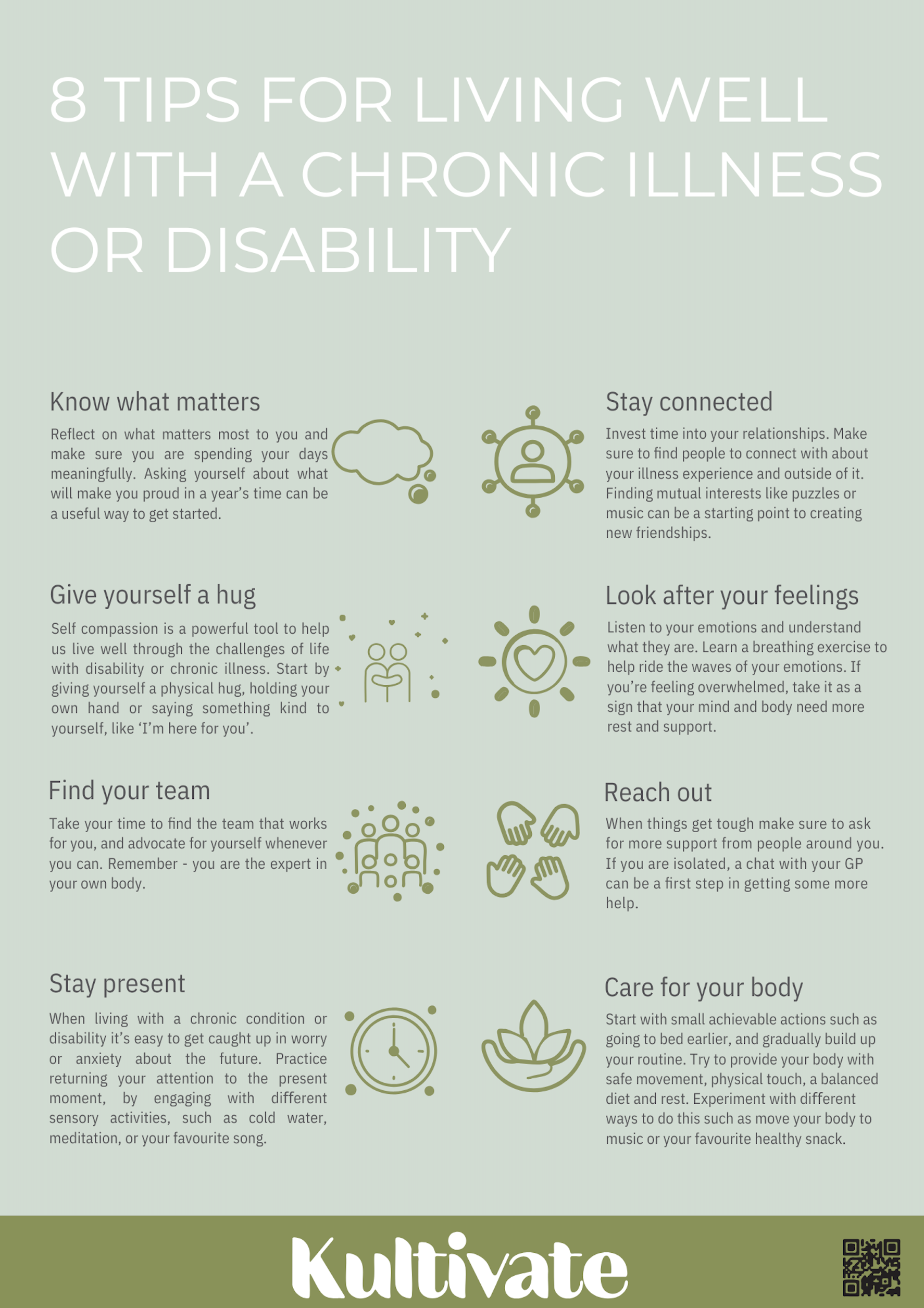
1. Know what matters
Reflect on what matters most to you and make sure you are spending your days meaningfully. Asking yourself about what will make you proud in a year’s time can be a useful way to get started.
It is common to feel lost or unsure about where to go, especially after a new diagnosis or when things are hard.
2. Give yourself a hug
Self-compassion is a powerful tool to help us live well through the challenges of life with disability or chronic illness. Start by giving yourself a physical hug, holding your own hand, or saying something kind to yourself, like ‘I’m here for you’.
If being kind to yourself is very difficult for you, start small by asking yourself how you would support a friend going through a tough time, and do the same for yourself.
3. Find your team
Take your time to find the team that works for you, and advocate for yourself whenever you can. Remember- you are the expert in your own body.
Each person is different, but it is worth exploring options for a trusted General Practitioner, Physiotherapist, Psychologist, Occupational Therapist and any other allied or specialist health providers you may benefit from.
4. Stay present
When living with a chronic condition or disability, it’s easy to get caught up in worry or anxiety about the future. Practice returning your attention to the present moment, by engaging with different sensory activities, such as cold water, meditation, or your favourite song.
Staying mindful in the present moment can be hard if you’re not used to it, and can also require various aids for some of us. Using a meditation app or fidget aids may be useful to explore.
5. Stay connected.
Invest time in your relationships. Make sure to find people to connect with about your illness experience and outside of it. Finding mutual interests like puzzles or music can be a starting point to creating new friendships.
It is normal to feel disconnected or even lonely when receiving a new diagnosis or when things change with our bodies. Finding your people and community is crucial, and often requires ongoing work in reaching out, creating and developing existing relationships.
6. Look after your feelings
 Listen to your emotions and understand what they are. You can do this by learning a breathing exercise to help ride the waves of your emotions, journaling or speaking with a mental health professional.
If you’re feeling overwhelmed, take it as a sign that your mind and body need more rest and support.
7. Reach out
When things get tough, make sure to ask for more support from people around you. It is easy to fall into the trap of thinking we need to manage everything alone, but that is impossible for any of us.
If you are isolated, a chat with your GP can be a first step in getting some more help.
8. Care for your body
Start with small achievable actions such as going to bed earlier, and gradually build up your routine. Try to provide your body with safe movement, physical touch, a balanced diet and rest. Experiment with different ways to do this such as move your body to music or your favourite healthy snack.
Remember that creating lasting change takes time, effort, and the right tools and support. If you don’t know where to start, reach out to a trusted friend or health professional.
Liel Bridgford
Psychologist, Writer, Educator
Kultivate Founder & Director
About Kultivate
Kultivate is a psychological practice created by and for people with disability, providing support and education that is lived-experience based and is rooted in disability justice. We believe that every person deserves to live their best life and envision an equitable society where all disabled and multiply marginalised people can thrive. Kultivate’s mission is to engage with disabled people to improve their quality of life and wellbeing through education, peer support and therapy.
Blog courtesy of Kultivate, a Patient Community Day Supporting Partner.