 When we speak about Multiple Sclerosis (MS), we often focus on the moment of diagnosis and frame it as the defining point, the answer after months or years of uncertainty. And rightly so. A diagnosis brings clarity, access to care, and often a first sense of direction.
This year’s World MS Day 2026 theme, “My MS Diagnosis,” highlights exactly that: the importance of getting that moment right earlier, faster, and with the right support around it.
But if diagnosis is where the story begins, understanding happens over time.
It unfolds in the months and years that follow, in subtle changes that cannot be captured in a single consultation, in patterns that only emerge when experiences are not isolated, but connected. This is where cohorts quietly, but fundamentally, reshape the landscape of MS.
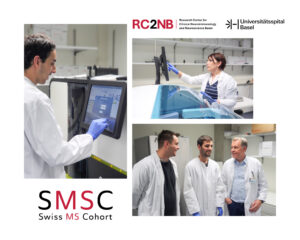 In Switzerland, the Swiss MS Cohort Study (SMSC) has built exactly that kind of continuity. As a nationwide, longitudinal study, it follows people living with MS over time through standardized clinical, imaging, and biological data collection. Its aim is simple but powerful: to better understand how MS evolves, how it responds to treatment, and how it differs from one person to another.
In many ways, cohorts create something larger than data alone. They create continuity. A collective memory within the healthcare and research system. A way to ensure that each diagnosis does not stand alone, but contributes to a growing understanding that benefits the entire MS community.
At the Research Center for Clinical Neuroimmunology and Neuroscience Basel (RC2NB), this continuity is foundational to how research is designed and conducted. Many study participants are already part of the SMSC, arriving with years of clinical history that allow researchers and clinicians to better understand how MS evolves and how care can become more precise, personalized, and meaningful for each individual.
The tagline of 2026 World MS Day, “Navigating MS Together” is often understood as a deeply human message, including patients, families, clinicians, and researchers supporting one another. But beyond that, there is another aspect to this about building systems
where experiences are not lost, where knowledge accumulates over time, and where every contribution strengthens the whole, and only cohorts can make that possible. They connect individual journeys into a shared path of understanding, turning personal experiences into collective progress.
And behind every dataset, every MRI, every follow-up visit, is a person whose experience contributes to something larger than themselves. As one participant involved in the Swiss MS Cohort and ongoing studies at RC2NB shared: “If my experience can help someone else, why wouldn’t I share it?” For him, living with MS also means recognizing the importance of support, connection, and community: “Don’t face it alone. Talk to your doctor, join a self-help group, and connect with your local MS Society. It’s about building a team to face challenges together.”
His words capture the deeper value of cohorts and long-term research participation. They remind us that progress in MS is built through a combination of technology, data, science, and, more importantly, through people willing to share their journeys so that future patients can benefit from greater understanding, earlier interventions, and better care.
On this World MS Day 2026, we are reminded that while diagnosis may define the beginning of an MS journey, real progress depends on our ability to connect experiences over time and transform them into understanding that improves care for everyone who follows.
Learn more about the Swiss MS Cohort Study: https://smsc.ch/
About the Research Center for Clinical Neuroimmunology and Neuroscience Basel (RC2NB)
The Research Center for Clinical Neuroimmunology and Neuroscience Basel (RC2NB) is a leading destination for cutting-edge research and clinical innovation. As an academic-industry initiative, we are committed to advancing Neuroimmunology and Neuroscience, focusing on understanding and treating Multiple Sclerosis and other neuroimmune diseases. In collaboration with the MS Center at the University Hospital Basel, RC2NB delivers an interdisciplinary approach to patient-oriented research and care.